My research investigates how language models retain and use information over time: what persists
within their internal representations, how that state might serve as persistent long-term memory for agents and robots,
and how a language model can act as the cognitive layer of a robot that learns from experience rather than from
training.
PhD research proposal
Persistent State Memory in Hybrid Language Models
Large language models are stateless between sessions. Hybrid architectures such as Qwen3.8 replace most
attention layers with linear-attention layers (Gated DeltaNet), which summarise the preceding context in a fixed-size
recurrent state that can be saved, stored and reloaded. This proposal will (1) derive and test the capacity and
interference limits of such states as persistent memory; (2) design and evaluate methods to save, compose and reload
states together with a small set of attention key-value pairs; and (3) develop a verifier-gated continual-learning
loop that commits only verified improvements to memory. Evaluation employs controlled synthetic tasks and public
benchmarks (BABILong, LongMemEval, MemoryAgentBench) against strict, compute-matched baselines.
Hybrid LLMsGated DeltaNetLong-term memoryContinual learning
Draft · October 2026
Kedalion: A Cognitive Control Layer for Robotics
Kedalion is a cognitive control layer that enables a robot to acquire task-level skills without reinforcement
learning, training or modification of model weights. A reasoning language model serves as the robot's cognitive
core: it derives a model of its embodiment from the URDF and hardware configuration, then plans, acts, verifies
outcomes against sensor data and reflects, iterating until the goal is verified. Successful and unsuccessful attempts
are stored as reusable strategies, so that performance improves with experience rather than training. Cognition is
distributed across three agents, Prometheus (planning), Epimetheus (reflection) and Mnemosyne (memory), while
time-critical and exact functions (state estimation, inverse kinematics, goal verification and safety) remain in
deterministic code and MCP tools; humans observe and guide rather than control. The study evaluates sample
efficiency and cost relative to reinforcement learning, the effect of sensor-verified goals on false success reports,
and cross-embodiment transfer by substituting only the URDF.
LLM agentsRobot learningMemoryURDFMCPHuman-on-the-loop
Research study plan · October 2026
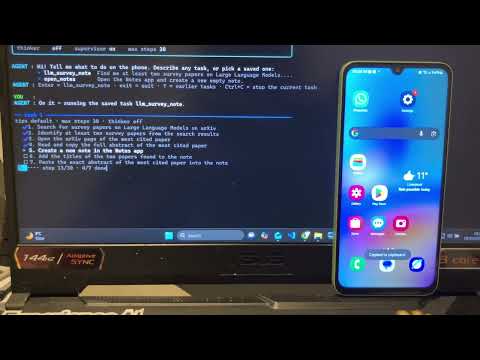
MIMIC: Coverage-Guided, Explainable LLM Agents for Fleet-Scale Mobile Testing
LLM-based GUI agents can now complete natural-language tasks on Android, but they are evaluated on task success
rather than on their value as test instruments. This study investigates whether GUI agents driven by operational-profile
personas and steered by functional-coverage feedback can test mobile software more effectively than random,
model-based and scripted baselines (Monkey, Sapienz-style search, DroidBot and existing LLM testers), while remaining
explainable, reproducible and non-intrusive to the device under test. MIMIC separates what to test (a persona
engine with a coverage map) from how to act on screen (a replaceable open-weight GUI agent), runs entirely
on-premises across emulated and physical devices, and records every action in an audit ledger for deterministic fault
replay. Evaluation uses benchmarks with known faults (Themis, AndroidWorld) and measures coverage, fault detection,
reproducibility and device overhead, within a closed test environment with built-in safety limits.
LLM GUI agentsSoftware testingCoverage guidanceExplainabilityAndroid
Proof-of-concept video
Ongoing · R6–R10 complete
Recoverability of Token Identity in Delayed Transformer Hidden States
A preregistered experimental programme on frozen Qwen3-4B representations examines whether the exact identity
of a token remains recoverable from later hidden states after further tokens have been processed. At the token's own
position, identity is strongly recoverable: top-1 accuracy of 40.2% over a 151,655-token vocabulary, against a matched
null of 0.5%. At a delay of 64 tokens, direct, linear, multi-position and non-linear decoders all fail to exceed matched
structural nulls, suggesting that apparent retention largely reflects structural regularities (token family, length
and position) rather than unique token identity. The programme separates these effects through held-out evaluation,
matched nulls and bootstrap confidence intervals, and is proceeding to a new prospective direction (R11).
InterpretabilityProbingQwen3Preregistration
Ongoing
LatentRecall: persistent hidden-state memory for frozen language models
LatentRecall investigates whether a pretrained language model can acquire persistent memory without updating
its weights or retaining the original conversation as text. It captures model-native hidden-state traces of new
experiences, stores them as latent memories and uses them to reconstruct information after the original context has
been removed.
MemoryTransformers
Code